
Why you feel lost during global uncertainty (Human Design explanation)
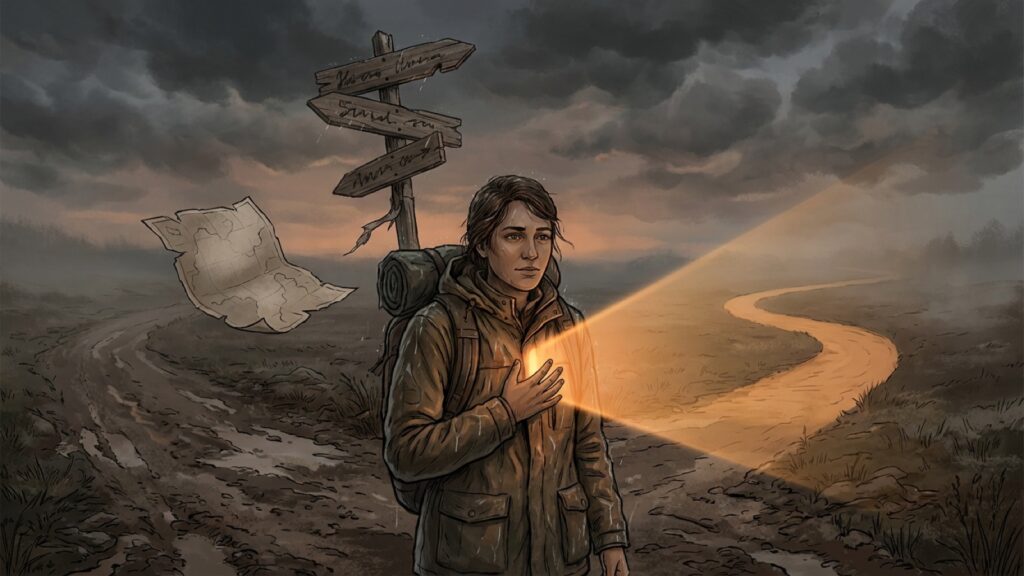
When the outside world feels unstable, a strange thing can happen inside you: the path that felt obvious a month ago suddenly feels foggy. Plans that used to feel solid can look thin. Confidence can vanish for no dramatic reason. In Human Design, that experience is not always a sign that you are failing or falling behind. Very often it is what happens when collective pressure enters sensitive parts of your system and starts sounding like your own voice.
Many people make this personal. They assume the feeling of being lost means they are weak, unprepared, or off track. Human Design offers a different explanation. It shows how uncertainty can move through the Head, Ajna, Emotional Solar Plexus, and Root centers in ways that distort perception, increase urgency, and make borrowed pressure feel deeply personal. Once you understand that pattern, you can stop treating confusion like a character flaw and start treating it like information.
Why uncertainty scrambles your sense of direction
Human Design is not just about personality labels. It is about how energy is taken in, amplified, and expressed. During periods of global uncertainty, the chart often reveals where you are most likely to lose orientation.
The Head center is mental pressure. If your Head is open, you can become highly sensitive to the questions and fears moving through the collective. Suddenly you are trying to solve problems that are not actually yours. You may feel compelled to understand every trend, predict every outcome, or mentally prepare for every possible disaster.
The Ajna is how the mind organizes information. If your Ajna is open, uncertainty can feel especially destabilizing because your mind wants fixed answers in a moment that is still changing. You may swing between viewpoints, over-research simple decisions, or force yourself into opinions just to stop the wobble.
The Emotional Solar Plexus shapes emotional experience. If it is open, other people’s fear, grief, frustration, or volatility can become louder inside you than it is inside them. If it is defined, you still feel intensity, but it tends to move through your own emotional wave rather than purely as borrowed atmosphere.
The Root is pressure to act. When the Root is open, outside urgency can feel like a command: decide now, move now, fix now. Even people with a defined Root can feel extra pressure in uncertain times, but open Root people often experience urgency as something they must discharge immediately, even when there is nothing correct to force.
What feeling lost can look like in daily life
Being lost does not always look dramatic. Sometimes it looks like opening ten tabs and still not trusting the answer. Sometimes it looks like changing your plans every other day. Sometimes it looks like exhaustion after a few conversations because you are carrying emotional weather that never belonged to you in the first place.
You may also notice that simple choices become strangely heavy. What should I focus on? Should I change jobs? Should I move faster? Should I hold back? When collective fear rises, the nervous system can interpret ordinary timing questions as survival questions. That is why small decisions can suddenly feel enormous.
In Human Design terms, this often means your system is overloaded with amplified pressure. The problem is not always that you need a better answer. The problem may be that you are trying to answer from a crowded internal state.
Openness does not mean weakness
One of the most helpful reframes in Human Design is that openness is not a defect. Open centers are places of sensitivity, learning, and amplified awareness. In the right conditions, they become wisdom. In the wrong conditions, they can become confusion, urgency, or over-identification with what other people are feeling.
This is why two people can live through the same external moment and report very different inner realities. One person may be flooded emotionally. Another may be trapped in mental overdrive. Another may seem calm until they step into a stressful environment and instantly lose contact with themselves. None of that means one person is more evolved than another. It means their charts process pressure differently.
When you understand this, a better question appears: what in this feeling is actually mine, and what am I amplifying? That question alone can soften a lot of unnecessary self-judgment.
Why the mind gets louder when life gets less clear
When life feels unstable, the mind usually tries to compensate. It scans for patterns, predicts outcomes, compares timelines, and rehearses future problems. This can look responsible, but in Human Design the mind is not your decision-making authority. Its job is to notice, interpret, and describe. Its job is not to manufacture certainty on demand.
That is why so many people feel more lost the harder they think. They are asking the mind to perform a role it was never designed to perform. The mind can offer insight, language, and perspective. Under pressure, it can also produce fear disguised as logic. If every new thought makes you less steady, it may not mean you need more analysis. It may mean you need a different decision process.
How Strategy and Authority bring you back to solid ground
In Human Design, Strategy describes how your type is designed to move with life. Authority describes where reliable inner truth is found in your body. Together they reduce distortion.
Strategy helps you stop chasing certainty
Generators and Manifesting Generators are designed to respond instead of force movement from the mind. Projectors are designed to value recognition and direction over constant proving. Manifestors are designed to initiate from a real internal impulse, not from panic. Reflectors need time and environment to observe the field before landing anywhere stable.
When you return to Strategy, you stop demanding that life become instantly clear on mental terms. You begin relating to uncertainty in a way that matches your design.
Authority helps you find your own signal again
Authority keeps you from making important decisions from borrowed pressure. Emotional Authority needs time and clarity across the wave. Sacral Authority responds in the moment through body truth. Splenic Authority is immediate and quiet. Ego Authority knows through desire and willingness. Self-Projected Authority hears truth in the sound of its own voice. Reflectors need a longer cycle to distinguish temporary pressure from what is genuinely correct.
You do not need perfect certainty before every step. You need enough contact with your Authority to tell the difference between your own inner signal and the collective noise around it.
Practical ways to come back to yourself
- Notice where pressure lands first. Is it in your thoughts, your emotions, or your need to rush?
- Reduce noise before demanding clarity. Less information often reveals more truth.
- Ask whether this decision truly needs an answer now, or whether urgency is being amplified by the environment.
- Return to your type’s Strategy before making new plans.
- Use simple body language instead of mental arguments: does this feel steady, forced, warm, contracted, or open?
Feeling lost during global uncertainty is not always a sign that you are off path. Sometimes it is a sign that collective pressure is moving through sensitive parts of your design. The more clearly you understand how your chart processes that pressure, the less likely you are to build your next step on borrowed fear.
Want more clarity from your own design? Create your free chart and explore your Strategy and Authority inside HumanDesign.ai.