
Projector burnout during economic downturns
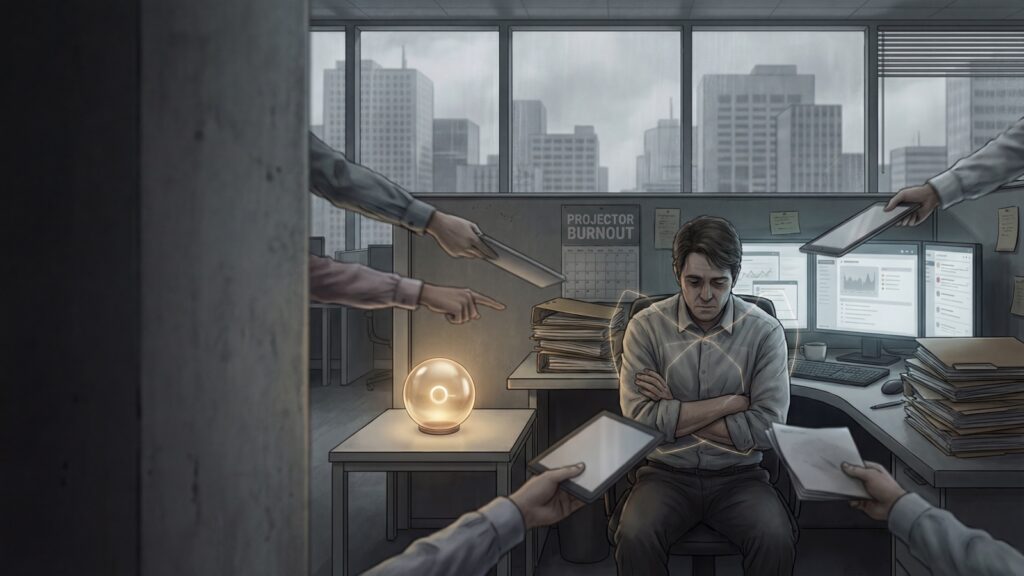
Economic downturns can hit Projectors in a very specific way. It is not only the pressure of money, work, or uncertainty. It is the way unstable periods can trigger the Projector tendency to prove, over-give, stay available, and mistake exhaustion for devotion. When recognition feels scarce, many Projectors respond by offering even more of themselves. That is often where burnout begins.
Human Design does not say Projectors should avoid work or ambition. It says Projectors are not designed to sustain the same output model as energy types. Their wisdom is directional. Their gift is guidance, perspective, and seeing systems clearly. During a downturn, however, that gift can get buried under fear if the Projector starts chasing security through overextension.
Why downturns trigger Projector overdrive
Projectors are deeply sensitive to recognition. When life feels stable, that sensitivity can be beautiful. It helps them feel where their attention is wanted and where their insight can land. During economic instability, that same sensitivity can become distorted. Fewer invitations, slower momentum, and more collective fear can make a Projector feel unseen or replaceable.
That is when many Projectors begin to over-function. They say yes too quickly. They give more advice than was invited. They work longer to prove usefulness. They stay in draining spaces because scarcity whispers that rest is dangerous. None of this is random. It is a nervous system trying to create security through effort that the design cannot sustainably maintain.
What burnout can look like in a Projector
Projector burnout is not only physical fatigue. It can look like resentment hidden under helpfulness. It can look like giving excellent insight while secretly feeling empty. It can look like staying hyper-available in the hope that someone will finally recognize your value.
Some Projectors become mentally overstimulated because they are tracking every possible outcome. Others become emotionally exhausted from managing the fear of the people around them. Others push themselves into energy patterns that simply do not fit their system and then blame themselves for not keeping up.
The common thread is misalignment with correct recognition and correct energy use. Burnout grows when a Projector keeps trying to earn what is meant to be recognized.
This can affect work, money, and relationships at the same time. A Projector may take on extra labor at work, extra emotional management at home, and extra visibility online, all while telling themselves that things will calm down once they have proven enough. Usually the opposite happens. The system gets more depleted, the insight gets less sharp, and the chase becomes harder to stop.
Scarcity can make the wrong strategy look responsible
This is one of the hardest parts. In a downturn, overworking can look mature. Over-giving can look generous. Constant availability can look committed. But from a Human Design perspective, these patterns often pull Projectors farther away from their real strength.
A burnt-out Projector is usually not lacking effort. They are often applying their energy in places where it is not being correctly received. The issue is less “do more” and more “where am I spending life force without true recognition?”
Recognition does not only mean praise. It means your presence, insight, and direction are actually wanted. Without that, the Projector can pour extraordinary energy into situations that never return steadiness.
During a downturn, this can feel counterintuitive. The mind says any opportunity is better than no opportunity. But Projectors often pay a higher price for misaligned opportunities because their systems are not designed for endless output. What looks like responsibility in the short term can become deep depletion in the medium term.
What supports Projectors during unstable periods
First, boundaries matter more than image. A Projector cannot build long-term stability by treating every request as urgent. Second, rest is not a luxury. It is part of how the system stays accurate. Third, discernment matters more than exposure. Not every room deserves your guidance.
It also helps to remember that waiting is not the same as doing nothing. A Projector can refine their offer, strengthen their message, deepen their craft, and care for their system without chasing every opening out of fear. Often the clearest invitations come when the Projector has stopped broadcasting desperation.
Support also looks practical. It may mean shorter work blocks, clearer client boundaries, more recovery after high-attention interactions, and a smaller number of places where your guidance is genuinely valued. The goal is not isolation. It is accuracy. Projectors thrive when their attention is invested where it can actually land.
What correct recognition feels like
Correct recognition usually feels steadier than scarcity-chasing. There is less performing in it. Less explaining. Less trying to convince people of what you can see. You may still feel stretched by an opportunity, but you do not usually feel like you have to abandon yourself to keep it.
That is an important standard during economic uncertainty. If a new opening demands constant overextension just to maintain contact, it may not be the kind of recognition your design can sustainably build on.
Practical questions for Projectors in downturns
- Am I offering guidance where it is actually welcome, or where I hope it will finally be valued?
- What part of my current workload comes from fear rather than correct recognition?
- Where am I staying visible at the cost of my own nervous system?
- What would better boundaries protect right now?
- What kind of rest would help me become accurate again, not just temporarily less tired?
Projector burnout during economic downturns is real not because Projectors are fragile, but because scarcity can push them toward strategies that betray their design. The correction is not passivity. It is returning to recognition, boundaries, rest, and the understanding that correct invitations are worth more than constant output.
Want more clarity from your own design? Create your free chart and explore your Strategy and Authority inside HumanDesign.ai.