
Why some people panic in chaos and others stay calm
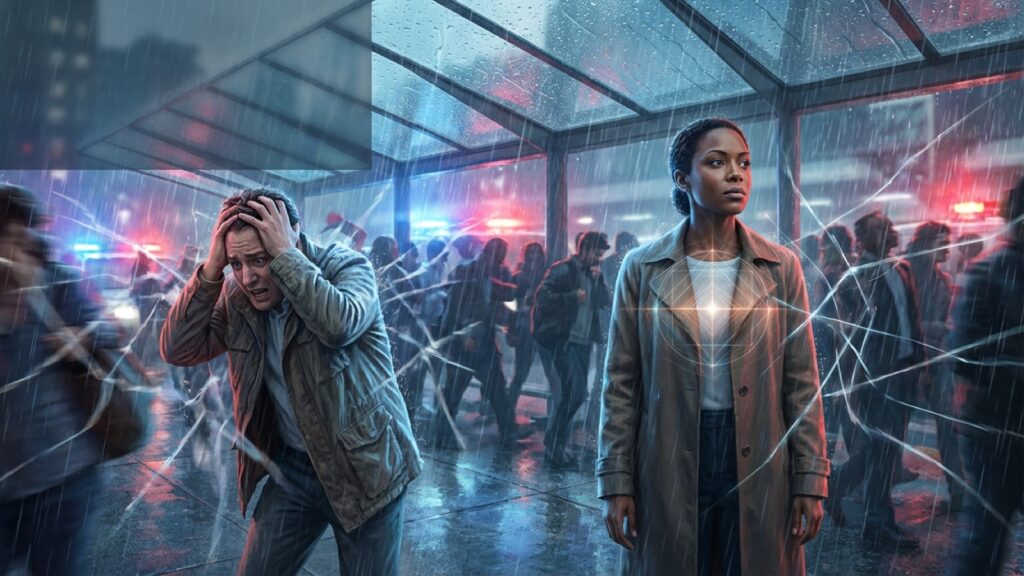
When life becomes chaotic, one person can spiral while another becomes strangely steady. It is tempting to turn that into a moral story. We assume the calm person is stronger, wiser, or less affected. Human Design gives a more useful explanation. People do not process pressure the same way, and calm is not always what it looks like from the outside.
Some people amplify collective fear. Some move through an emotional wave before they can see clearly. Some feel immediate survival instincts through the Spleen. Some feel intense pressure in the Root and try to discharge it through action. None of that makes anyone better or worse. It simply means different charts are built to experience chaos in different ways.
Calm is not superiority, and panic is not failure
One of the easiest mistakes to make in uncertain periods is to judge your internal response against someone else’s visible behavior. A person who looks calm may still be carrying a lot internally. A person who looks activated may be amplifying a room full of fear rather than generating it from nowhere.
Human Design helps because it moves the conversation away from character judgment and toward energetic mechanics. Instead of asking, “What is wrong with me?” you can ask, “How does my system process pressure?” That shift is often the beginning of real self-trust.
The Emotional center can turn atmosphere into certainty
The Emotional Solar Plexus is one of the clearest reasons people react differently under chaos. If this center is open, emotional energy from the environment can become magnified inside you. In a stressed family, workplace, or friend group, you may feel everything at once and assume the intensity means immediate danger. The issue is not weakness. The issue is amplification.
If the Emotional Solar Plexus is defined, there is still no guarantee of instant calm. Defined emotional people move in a wave. Their clarity often comes over time, not on demand. During chaotic periods, they may look composed one day and overwhelmed the next, not because they are inconsistent, but because their process is cyclical.
Both patterns can be misunderstood. Open emotional people may think they are too sensitive. Defined emotional people may think they should already know what to do. In both cases, the nervous system improves when they stop treating immediate intensity as final truth.
The Spleen and the Root shape urgency in different ways
The Spleen is the center of instinct, survival awareness, and immediate intelligence. When this part of the chart is active, people can have sharp, fast, body-level responses to what feels safe or unsafe. That can look like calm intuition or sudden alarm, depending on the moment and the person. Splenic sensitivity is not a rational process. It is immediate.
The Root is different. Root pressure creates movement, urgency, and the desire to get out from under stress. If the Root is open, outside pressure can feel overwhelming because it does not have a stable internal pace. If the Root is defined, there may be more consistency in how pressure is handled, but that does not mean the person enjoys chaos. It only means the pressure has a more familiar rhythm.
When panic appears, it is often not because someone is incapable of handling life. It is because the body is receiving pressure in a way that feels impossible to ignore.
Type differences matter too
Generators and Manifesting Generators often feel frustration when chaos blocks momentum or prevents clear response. If they cannot move energy correctly, tension builds. Projectors can panic when external instability makes them feel invisible, over-responsible, or pressured to prove their value. Manifestors may react strongly when uncertainty threatens their autonomy or ability to move independently. Reflectors can become deeply affected by the health of the wider environment because they sample it so thoroughly.
These are not hard rules. They are recurring tendencies. Human Design does not flatten people into a script. It helps explain why two nervous systems can meet the same event and still translate it through very different internal pathways.
Environment plays a real role here too. A person who looks calm in one setting may feel completely different in another. This is especially true for people with a lot of openness in the chart. The body is always in relationship with the room, the conversation, and the emotional field around it. Sometimes the most useful question is not “Why am I reacting like this?” but “What am I reacting to in this environment?”
What actually helps in chaotic moments
Most people try to regulate chaos by controlling more. Human Design often points in a different direction. Regulation starts with recognizing the kind of pressure you are dealing with.
- If the pressure is emotional, create space before you believe the feeling.
- If the pressure is mental, stop demanding certainty from the mind.
- If the pressure is instinctive, slow down enough to tell the difference between immediate awareness and generalized fear.
- If the pressure is Root-based, check whether you are moving because it is correct or because you cannot tolerate the sensation of waiting.
This is also where Strategy and Authority become practical instead of abstract. The person who stays calm is not necessarily calmer by nature. Often they are simply less identified with borrowed pressure, or more practiced at letting their body lead instead of their panic.
Questions that help you understand your own pattern
- Do I become more reactive around other people’s fear?
- Do I rush because action is correct, or because I need relief from pressure?
- Do I confuse strong emotion with clear truth?
- Does calm return when I step away from the environment?
- What does my body do before my mind starts telling stories?
It can also help to remember that staying calm is not always the goal. Accuracy is. Sometimes your body really is picking up on something important. The task is to respond from correctness rather than from escalation. Human Design gives you a language for making that distinction.
Chaos does not reveal who is superior. It reveals how differently people are wired to process instability. Human Design can help you stop comparing reactions and start understanding your own.
Want more clarity from your own design? Create your free chart and explore your Strategy and Authority inside HumanDesign.ai.